


Discover why custom cakes cost more than grocery store alternatives. Learn about labor, ingredients, design, and what you're actually paying for.
Table of Contents
- Why Custom Cakes Cost More Than Grocery Store Cakes
- The Real Cost Breakdown: What You're Paying For
- Custom Cake Pricing Factors That Drive the Cost
- Custom Cake Cost for 20 People: What to Expect
- How Far in Advance to Order a Custom Cake
- Ways to Reduce Cost Without Sacrificing Quality
- How to Compare Quotes and Avoid Surprise Charges
- Frequently Asked Questions
Last Updated: October 5, 2026
Why Custom Cakes Cost More Than Grocery Store Cakes
Custom cakes expensive because they're fundamentally different products from grocery store cakes. A grocery store cake is mass-produced for volume and shelf stability; a custom cake is handmade to order for a specific event and person.
When you order a custom cake, you're paying for a baker's skill, time, and creative labor, the overhead of a small bakery, and getting exactly what you want.
The Real Cost Breakdown: What You're Paying For
A custom cake quote reflects why custom cakes expensive: the actual expenses of running a specialty bakery and delivering a handmade product.
Skilled Labor and Production Time
The biggest cost driver is labor. A trained baker commands higher wages than a factory line worker because they juggle multiple orders, troubleshoot on the fly, and deliver consistent quality under time pressure.
A simple two-tier custom cake might take 6 to 8 hours of labor from consultation through delivery setup: sketching the design, baking layers, preparing fillings and frostings, assembling tiers, and decorating by hand. A four-tier wedding cake with hand-sculpted sugar flowers and intricate piping can consume 15 to 20 hours.
That time includes expertise in flavor pairing, structural engineering, color theory, and design execution.
Premium Ingredients and Sourcing
Custom bakeries typically use higher-quality ingredients than mass-production facilities: real butter instead of shortening, fresh eggs, quality vanilla, and often organic or locally sourced flour and dairy.
Fresh ingredients cost more: a bakery sourcing berries for delivery day pays more than a factory buying them weeks ahead and freezing them. Vegan or gluten-free options climb further.
The baker also builds in waste. Not every batch of cake layers comes out perfect, and that waste is built into the cost of every cake.
Handmade Design and Decoration
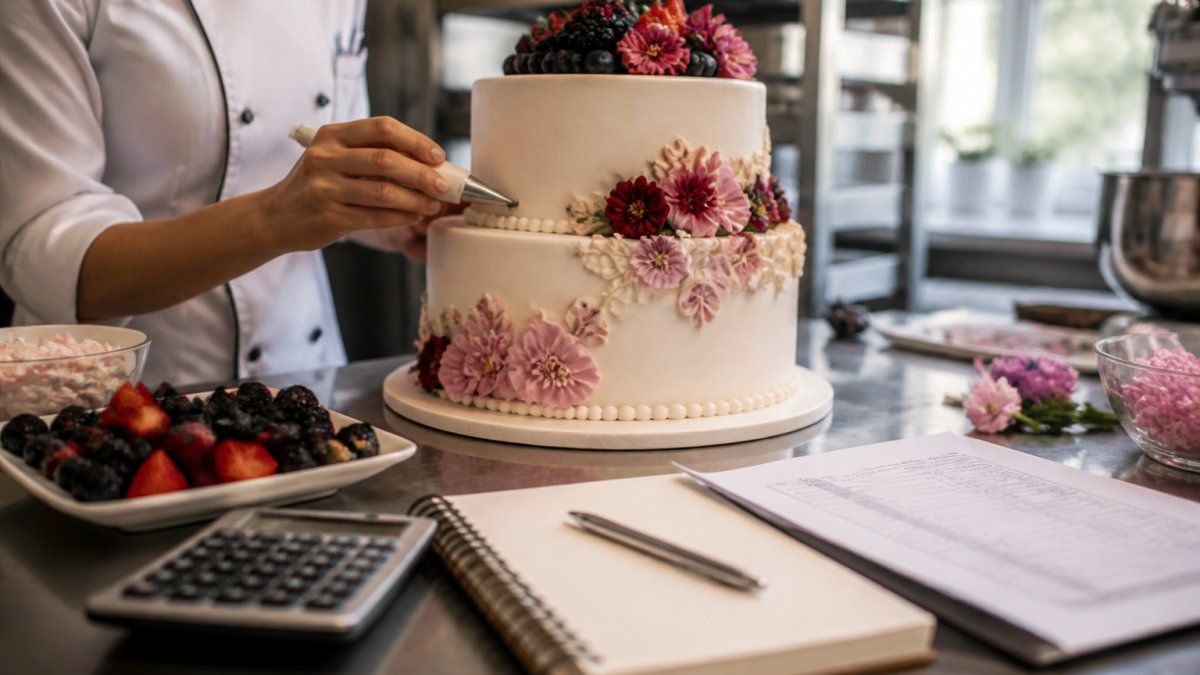
Decoration is where custom cakes diverge most from grocery store cakes. A grocery store cake gets thin generic frosting and machine-applied sprinkles; a custom cake gets hand-piped details, hand-sculpted elements, or carefully applied fondant designs.
Each piped rosette and hand-painted detail takes time, a baker might spend 3 to 4 hours decorating a wedding cake alone.
Design complexity directly impacts price: a simple buttercream finish costs less than fondant, which costs less than hand-sculpted sugar flowers.
Custom Cake Pricing Factors That Drive the Cost
Several variables determine where your cake lands on the price spectrum.
Cake Size, Tiers, and Guest Count
A custom cake for 20 people is a fundamentally different product from one for 100. The larger cake requires more ingredients, more structural support, and more baking and decorating time.
Tiered cakes cost more than single-tier cakes of the same total servings because each tier requires separate baking, assembly, and decoration.
Design Complexity and Customization
A simple buttercream-and-fresh-berry design costs less than one with hand-piped details and custom toppers, and a single color scheme costs less than multiple colors and intricate patterns.
Hand-sculpted elements add significant cost. A cake that looks exactly like something specific, a building replica, an edible-paint portrait, is custom artisan work.
Customization also affects timing: complex designs need more lead time, and rush orders carry a premium because they require rearranging the schedule.
Custom Cake Cost for 20 People: What to Expect
Most custom bakeries price by the serving, not the cake. That's why a 20-person quote can land anywhere from roughly $150 to $600 or more depending on the bakery, market, and design.
Here's how a sample quote for a 20-serving, two-tier buttercream cake with fresh fruit decoration typically breaks down at a mid-range specialty bakery:
Cost category |
Typical share of quote |
What drives it |
|---|---|---|
Ingredients |
15-25% |
Real butter, fresh eggs, quality vanilla, fresh fruit, specialty flours |
Skilled labor |
40-55% |
6-10 hours across consultation, baking, assembly, decorating, delivery |
Overhead |
10-20% |
Commercial kitchen rent, utilities, insurance, licensing, equipment depreciation |
Delivery and setup |
5-15% |
Distance, time of day, on-site assembly, refrigeration logistics |
Profit margin |
10-20% |
What keeps the bakery open for the next order |
Those percentages are a common pattern, not a rule: a home-based baker with low overhead may quote less, a high-end metro studio more.
How design shifts the number at 20 servings:
- Single-tier, buttercream, simple piping: the lowest end of custom pricing.
- Two-tier, buttercream, fresh flowers or fruit: the mid-range standard for birthdays and showers.
- Two-tier, fondant finish, hand-piped details: a step up, because fondant takes longer to apply, smooth, and finish than buttercream.
- Any design with sculpted elements: the top of the range, because those elements are made by hand.
Dietary accommodations move the number too. Vegan and gluten-free cakes require separate ingredient sourcing, separate equipment or thorough cleaning to avoid cross-contact, and often a test bake. Many bakeries add a flat surcharge.
USDA FoodData Central for standard serving-size references
The honest answer to 'what should a 20-person custom cake cost' is: it depends on the bakery, the market, and the design. The useful answer is that you can now read a quote and see where the money goes.
How Far in Advance to Order a Custom Cake
Lead time affects both availability and pricing. A baker with a full schedule weeks out can't take a rush order without turning you away or charging a premium.
Most custom bakeries recommend ordering 4 to 6 weeks ahead for standard custom cakes, giving the baker time to consult on design, source specialty ingredients, and schedule production.
If you need a custom cake in 2 to 3 weeks, many bakers can still accommodate you, but expect limited design options or a rush fee. A 1-week turnaround is possible for simpler designs, at a premium.
The reason isn't just scheduling: a baker under time pressure has less flexibility to troubleshoot and less time to source the best ingredients. That risk is factored into rush pricing.
Ways to Reduce Cost Without Sacrificing Quality
If a custom cake from a specialty bakery feels out of budget, there are legitimate ways to cut cost without sacrificing quality.
Simplify the design. A custom cake with buttercream frosting and fresh berries costs less than one with elaborate piping or hand-sculpted fondant work.
Choose a simpler shape. A round or square cake costs less than a complex tiered design.
Order during off-peak seasons. Custom bakeries are busiest in spring and summer (weddings) and November through December (holidays).
Reduce the guest count. A custom cake for 15 people costs less than one for 25, directly reducing cake size and cost.
Use the bakery's signature designs. Many custom bakeries have designs they make regularly.
Skip specialty dietary requirements if possible. Vegan and gluten-free cakes require specialty ingredients and careful handling.
The key is being honest about what matters most.
How to Compare Quotes and Avoid Surprise Charges
Two bakeries can quote the same cake at $250 and $400 and both be fair, because the quotes may not cover the same things. To compare fairly, make sure every quote answers the same questions in writing.
What a complete quote should include
A comparable quote will state, in writing:
- Servings and serving size. A '20-serving' cake means different things at different bakeries. Ask for portion dimensions (a common standard is roughly 1 inch by 2 inches by 4 inches for a celebration slice).
- Tiers and shape. Number of tiers, round or square, and whether the tiers are real cake or a mix of cake and dummy tiers.
- Flavor and filling. Specific flavors, not 'chocolate or vanilla.'
- Frosting type. Buttercream, fondant, ganache, whipped cream, or a combination.
- Decoration scope. What is included: piping, fresh flowers, fondant accents, sculpted elements. What is not.
- Delivery and setup. Whether the price includes delivery, on-site assembly, and a setup window, or whether you pick up.
- Rentals. Cake stands, pillars, tier separators, and display bases are often rented, not sold. Ask whether the rental is included and what the return deadline and damage policy are.
- Taxes and fees. Sales tax, delivery fuel surcharges, rush fees, and any card-processing fee.
- Deposit and payment schedule. How much to book, when the balance is due, and what payment methods are accepted.
- Revision and cancellation terms. How many design changes are included, what triggers a change fee, and what happens to your deposit if plans change.
Where surprise charges hide
Surprise charges are rarely the cake itself. They cluster in a few predictable places:
- Delivery distance. Many bakeries include delivery within a certain radius and charge per mile beyond it.
- Rush orders. Booking inside the bakery's standard lead time usually adds a percentage, not a flat fee.
- Design changes after deposit. Switching from buttercream to fondant, or adding a tier, after the quote is signed often reopens the pricing.
- Fresh flowers. If the design uses real flowers, the bakery may source them and pass through the florist cost, which varies by season.
How to compare two quotes side by side
Put both quotes side by side and check four things:
- Same servings, same serving size. If one quote is for 20 servings and the other is for 25, you're not comparing the same cake.
- Same decoration scope. A quote that includes fresh flowers and one that doesn't are different products.
- Same delivery terms. One quote may include delivery; the other may be pickup only.
- Same tax and fee treatment. Compare the final out-the-door number, not the headline price.
Once those four match, the remaining difference is usually labor and overhead, where a bakery's reputation, experience, and location legitimately show up in the price.
The goal isn't the cheapest quote, it's making sure the quote you accept covers everything you actually need, so the final invoice matches the number you agreed to.
Frequently Asked Questions
Why do custom cakes cost more than grocery store cakes?
Custom cakes involve skilled labor, premium ingredients, handmade decoration, and small-batch production. Grocery store cakes use mass-production methods, lower-cost ingredients, and pre-made designs. A custom cake is made specifically for you, with fresh, quality ingredients and hours of a baker's time invested in design and execution, whereas grocery store cakes are produced in bulk with shelf-stable components.
What factors affect the price of a custom cake?
Custom cake pricing factors include cake size and number of tiers, guest count and servings needed, design complexity and customization level, specialty ingredients or dietary options (vegan, gluten-free), delivery and setup requirements, and how far in advance you order. Rush orders typically cost more. The baker's overhead, equipment, and local business costs also influence the final price.
How far in advance should you order a custom cake?
Most bakers recommend ordering a custom cake 2-4 weeks in advance to allow time for design consultation, ingredient sourcing, and production. For complex designs or large orders, 4-6 weeks is ideal. Rush orders (3-7 days) are sometimes possible but usually cost extra. Check with your baker about their specific timeline and rush availability.
Are customized cakes worth the extra cost?
Yes, if quality, taste, and design matter for your occasion. Custom cakes offer fresh, premium ingredients, personalized designs that match your event, and the expertise of a skilled baker. For milestone celebrations—weddings, significant birthdays, anniversaries—a custom cake becomes a centerpiece and memory. If budget is the priority, grocery store cakes work, but custom cakes deliver superior flavor, presentation, and the assurance that your cake is made specifically for you.
